How games build a character
Kenshi and Saints Row: The Third both let you make a person from sliders, but they solve the problem in very different ways. The Sims (2000) has no sliders at all: it picks whole meshes by file name. This site explains, from the decompiled code and the shipped data, exactly how each one turns choices into a mesh and a texture. It also covers how they generate NPCs and how much variety each can produce. All three systems were re-implemented to the bit and checked against each other.
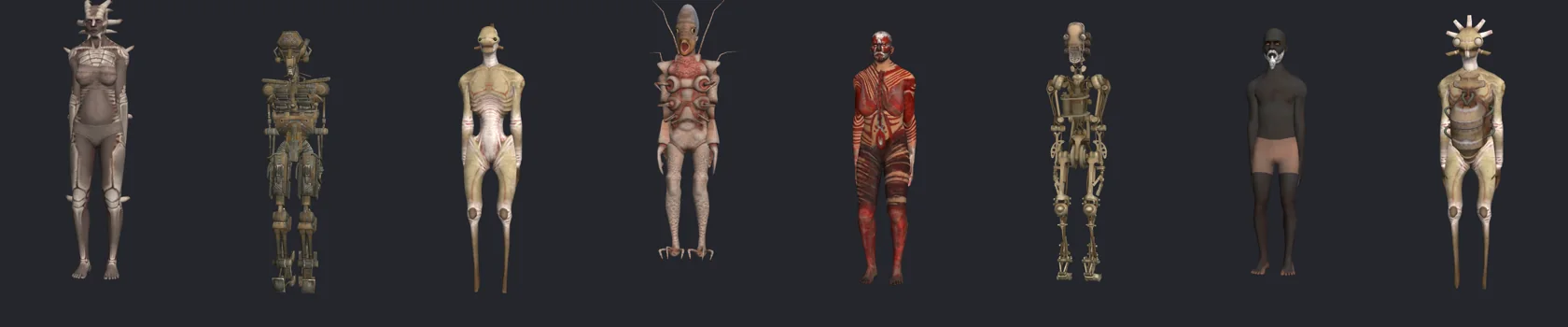
One skeleton, many races, faces seeded from a name
A single skinned body per race and gender, deformed by 8–27 morph targets and a set of per-bone scales. NPCs use the same system as the player. Their face shape is seeded from a hash of a string, so every generic NPC is one of five faces.
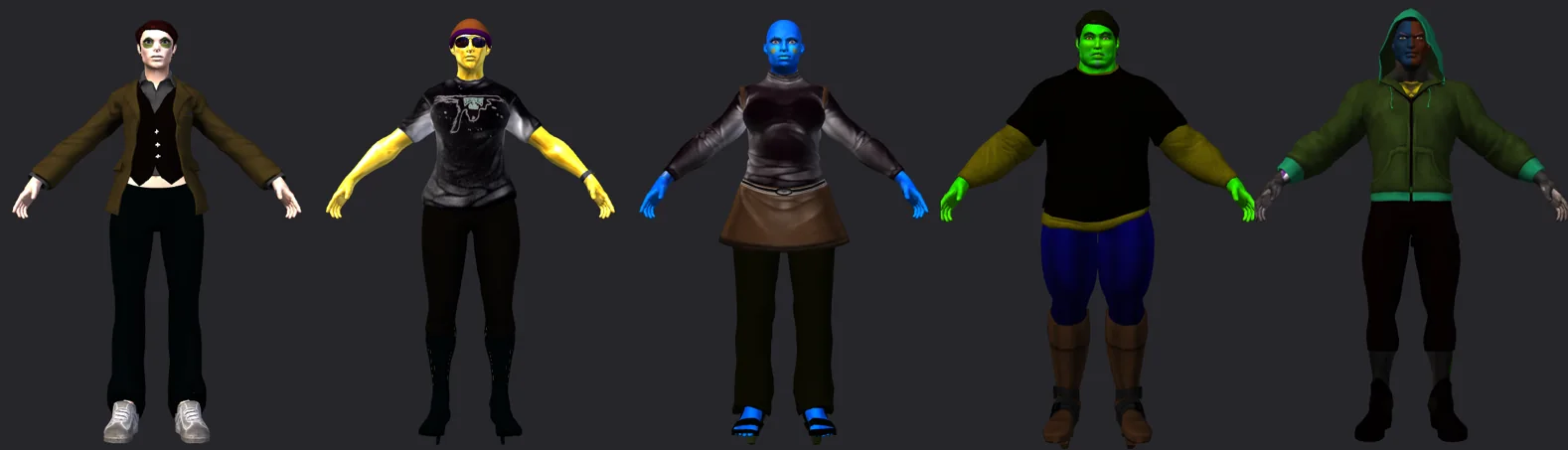
A dress-up doll with 110 sliders and 572 items
Two full-body meshes and about 115 morph targets that every hair style and garment also carries. The skin is a texture composited at runtime, lit through "shader balls". NPCs are a completely separate, hand-authored system, varied only by palette and props.
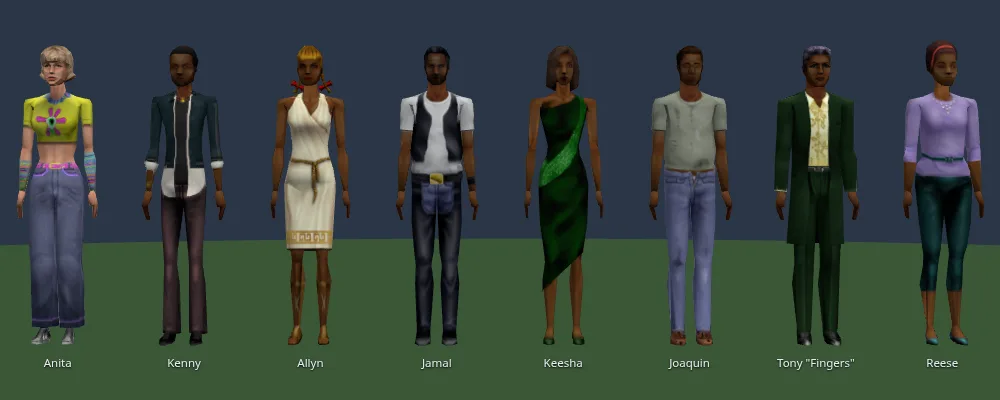
A catalogue of meshes chosen by file name
A head and a body, one texture each, from lists built by matching file names against patterns. Skin tone is a texture choice, outfits are whole bodies, townies are seeded from the clock, and babies inherit only their skin tone.
The answer in a few paragraphs
Kenshi
An editor XML file per race lists the sliders. A slider either drives a morph target (weight = value × 0.01) or sets a bone scale on a 30-bone 3ds Max Biped skeleton. Three posture sliders pick a frame in a skeleton animation. At spawn, the weights are baked into a private copy of the mesh. A shader adds a swappable head texture onto the body texture and darkens it by a 1-D skin-tone ramp.
Generic NPCs run the same code. They seed the random generator with an FNV-1a hash of
race_weirdness_Gender#, so the faces are identical in every save. Individual
NPCs differ in head texture, hair, skin and bone sizes.
Saints Row: The Third
A table of 110 sliders, each with keys that map the slider through a piecewise ramp onto named morph targets. Deltas are accumulated on the CPU into the body, and into every hair and clothing mesh, which carry their own copies of the same targets. Skin colour is an HSB shift of the body texture. Eyes, brows, beards, makeup and tattoos are sprites composited into one 2048×1024 texture. Normal detail is blended from five maps by the body sliders.
Clothing is 572 items dyed with three colours through pattern masks. Items hide body submeshes and switch each other's meshes with flags. NPCs don't use any of this. Each one is authored, and only its palette, props and hair tint vary.
The Sims
No sliders and no morphs. Create-A-Sim scans every loaded character file for names like
c###[m|u][a|c] (heads) and b###[m|u][a|c]### (bodies), and pairs each with every
texture named after it plus the skin tone. A choice is saved as a text "body string". Outfits are
separate bodies with their own name patterns, and new sims get defaults by a shortest-name best match.
Personality is 25 points over five traits; the star sign is the nearest of 12 presets.
Townies, NPCs and grown-up babies draw a uniformly random head and body from the same lists. Townies use an RNG reseeded from the clock, so a burst of them shares a gender. A baby inherits only its skin tone, from a randomly chosen parent.
How much variety?
Every independent choice multiplies the number of possible characters. Adding the orders of magnitude of each category gives the total. Kenshi's count comes almost entirely from its integer sliders. Saints Row's discrete choices are dominated by clothing dyes. The Sims is a catalogue: big for its time, tiny on this scale. Hover a segment for details.
What's here
Kenshi
Assets, sliders, bone sizes, posture clips, skin shader, hair, NPC seeding, quirks. Interactive slider maths and a live NPC face generator.
GameSaints Row: The Third
Packfiles, morph keys, presets and the body triangle, normal-map blending, the composite texture, hair, clothing dyes and flags, NPCs.
GameThe Sims
File-name patterns, body strings, outfits and best match, zodiac, clock-seeded townies, baby genetics, and the "infested" download.
AnalysisComparison
Stage-by-stage comparison, design philosophies, strengths and weaknesses, variety breakdown and lessons for building your own.
EvidenceMethod & evidence
Tools, file formats, how it was verified, known gaps, and the function maps for all three executables.
DemoKenshi creator ↗
All 30 races, every head, hair and beard, every slider, and the generic NPC faces, in three.js.
DemoSaints Row creator ↗
All 110 sliders, 572 items, 321 layers and 223 NPC types, loaded on demand.
DemoSims creator ↗
Every head, body and outfit, townies and children with the game's RNGs, all 314 characters and 35 pets.